Typically 20s to mid-30s
Type I (Mild/Early)
No or very few wrinkles, minimal pigment changes, makeup goes on effortlessly.

The Glogau Classification is a widely used clinical framework that categorizes the severity of facial photoaging — skin damage caused primarily by UV exposure — and wrinkles into four distinct stages. It is commonly used by dermatologists to assess skin conditions and determine the most appropriate anti-aging treatment. The system evaluates the presence of wrinkles, pigmentation, and keratoses (rough, scaly skin patches) to assign patients to one of the categories below.
Typically 20s to mid-30s
No or very few wrinkles, minimal pigment changes, makeup goes on effortlessly.
Typically 30s to 40s
Early wrinkling — smile lines and crow's feet that are only visible in motion. Mild sun spots (lentigines) may appear, and light foundation might be required.
Typically 50s to 60s
Wrinkles are present even at rest. Visible discoloration, broken capillaries (telangiectasia), and keratosis may be present.
Typically 60s +
Severe wrinkling across the entire face, with skin often taking on a yellow-grayish hue. Deep furrows are common, and precancerous or cancerous skin lesions may be present.
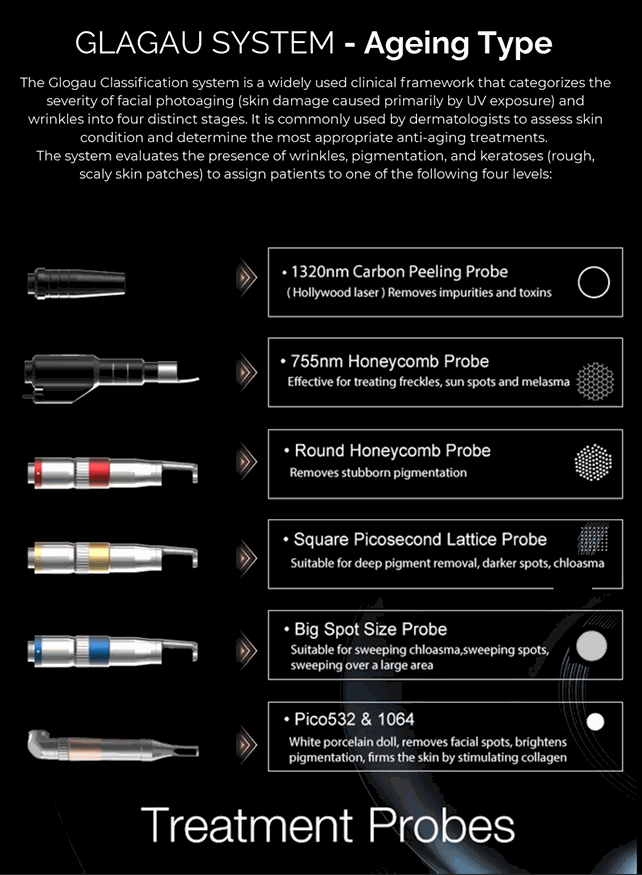
Age-Defy treatments include 2 probes for Standard and 3 probes for Advanced treatments, plus Biomedika Advanced Medical Skin Care.

Fifteen minutes, no charge, no obligation — a proper assessment of your skin, your goals and your history before anything is recommended.